
Why Desk Workers Can’t Switch Off at Night ?
Your Nervous System Doesn’t Know You’ve Left the Office
Here’s what most people don’t understand about stress: your body cannot distinguish between a deadline and a physical threat. Both activate the same system — the sympathetic nervous system, your body’s built-in fight-or-flight response. Cortisol rises. Heart rate elevates. Muscles contract to protect you. Breathing becomes shallow and moves into the chest.
The problem for desk workers is that this state doesn’t automatically switch off when you close your laptop. Chronic sympathetic activation — your nervous system staying in low-level alert for months or years — creates a physiological pattern that doesn’t reset just because your environment has changed.
You walk in the door, sit on the couch, and your muscles are still holding. Your upper trapezius is still slightly contracted. Your jaw muscles — the masseter and temporalis — are still braced. Your iliopsoas, the deep hip flexor that connects your lumbar spine to your femur, is still shortened from eight hours in a chair. These tissues don’t know it’s 10 pm. They’re responding to a state your nervous system is still broadcasting.
The Three Muscles That Keep You Awake
Most sleep advice focuses on screens and caffeine. Rarely does anyone talk about the specific muscles that prevent your body from genuinely relaxing.
The upper trapezius. This muscle runs from the base of your skull to the tip of your shoulder. In a typical office worker, it spends the entire workday in a low-grade isometric contraction — holding your shoulders up, bracing against keyboard tension, responding to every stressful email by quietly tightening. By the time you get home, it has been partially contracted for so long it no longer registers as tight. It just feels like your normal neck. But the muscle tension is still there, and so is the neural signal it’s sending back to your brain: we are not safe yet.
The suboccipitals. These four small muscles sit at the base of your skull and control the fine movement between your skull and the top two vertebrae. Forward head posture — which every desk worker develops — puts them into chronic compression. When these muscles are compressed and hypertonic, they restrict blood flow and nerve signalling at the very top of the cervical spine. Many people who lie down and immediately feel a dull headache or a sense of pressure at the back of their skull are feeling suboccipital compression.
The iliopsoas. Buried deep inside your pelvis, the iliopsoas is the only muscle that directly connects your spine to your legs. It’s also the muscle most associated with the fetal position — which is the position your body adopts when it feels threatened. After eight hours shortened in a seated position, a tight iliopsoas keeps a subtle anterior pull on your lumbar spine. That low-grade tension in your lower back you feel when you lie flat? Often that’s your iliopsoas. It cannot fully relax in supine until it has been adequately lengthened — which doesn’t happen by itself overnight.
What Shallow Breathing Does to Your Muscles
Chronic stress shifts your breathing from diaphragmatic — deep, belly-led breaths that fully oxygenate the lower lobes of your lungs — to accessory breathing, where the scalenes and SCM (sternocleidomastoid) in your neck pick up the work instead.
These muscles were designed to assist breathing during intense exertion, not to run your respiratory cycle all day. When they become the primary breathing muscles, they become chronically overworked, hypertonic, and tender. The scalenes in particular refer pain into the chest, shoulder, and down the arm — which some people mistake for heart symptoms or anxiety.
The deeper consequence is this: as long as your breathing stays shallow and chest-led, your parasympathetic nervous system — the rest-and-digest response that is the physiological opposite of fight-or-flight — cannot fully engage. Your body uses the depth and rhythm of your breathing as one of its signals about whether the environment is safe. Shallow breathing says: not yet.
How Massage Therapy Addresses the Pattern Directly
The reason massage can support better sleep isn’t simply that it “feels relaxing.” It works through specific mechanisms that desk workers respond to particularly well.
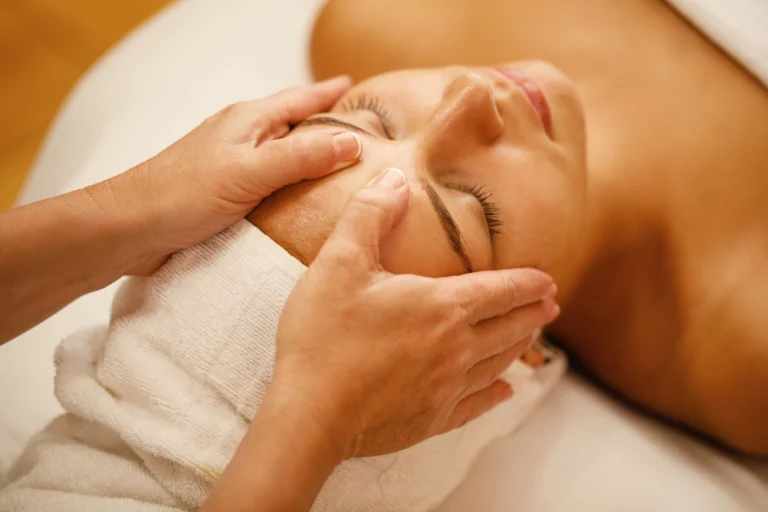
Manual work on the upper trapezius and suboccipitals reduces the hypertonic holding pattern in the muscles that have been bracing all day. Sustained pressure on trigger points in the levator scapulae and upper trapezius allows the muscle to neurologically release — the therapist isn’t just pressing on a knot, they’re interrupting the feedback loop between that muscle and the nervous system that keeps telling it to stay contracted.
Myofascial release along the thoracic spine and posterior shoulder girdle creates space for the ribcage to expand. When the thoracic fascia — the connective tissue binding your mid-back — is restricted from sustained forward flexion at a desk, your ribcage literally cannot expand to full capacity. Addressing that restriction allows diaphragmatic breathing to return, which directly activates the parasympathetic response.
Work on the iliopsoas — typically accessed in sidelying or supine with the hip passively supported — allows the anterior lumbar pull to release. Many clients report that this is the moment during a session where they feel their lower back actually contact the table for the first time.
Research suggests regular massage therapy may support a reduction in cortisol levels and an increase in serotonin and dopamine — the neurochemical shift that underpins the transition from sympathetic to parasympathetic dominance. Many clients find that the quality of sleep in the 48 hours following a massage session is meaningfully different from their baseline.
What You Can Do Tonight
Three things that address the specific physiology above — not generic sleep hygiene advice:
Diaphragmatic breathing reset — 5 minutes before bed. Lie flat. Place one hand on your chest, one on your belly. Your belly hand should rise first and more than your chest hand. If it doesn’t, you’re still chest-breathing. Slow the exhale to twice the length of the inhale. This directly stimulates the vagus nerve and begins the parasympathetic shift.
Doorframe pec stretch. Arms at 90 degrees in a doorframe, lean gently forward. Hold 30 seconds. This opens the anterior shoulder girdle that forward posture has shortened all day, allows the thoracic spine to extend, and creates room for a fuller breath.
Supported psoas release. Lie on your back with your feet flat on the floor and knees bent. Let your lower back soften toward the floor — don’t press it down, just allow it to release over 2–3 minutes. This passively lengthens the iliopsoas without requiring a stretch. Many people fall asleep doing this before they finish.
FAQ
Why do I feel more tense at night than during the day? During the workday, adrenaline and task-focus keep you from noticing the tension your body is holding. At night, when external stimulation drops, that background tension becomes noticeable. The tension was always there — you’re just no longer distracted from it.
Can massage really help with sleep, or is that just relaxation? The two aren’t separate. The physiological state that produces relaxation — reduced cortisol, activated parasympathetic nervous system, reduced muscle tone — is precisely the state that allows sleep to initiate and deepen. Research suggests massage may support this shift through specific neurological and hormonal mechanisms, not simply through comfort.
How often would I need massage to notice a difference in my sleep? For desk workers with chronic sympathetic activation, many RMTs recommend weekly sessions for the first four to six weeks, then bi-weekly or monthly for maintenance. The pattern you’re trying to interrupt has often built up over years — it responds to consistent treatment, not a single session.
URest Massage is an Edmonton RMT clinic. Book at urestmassage.com
GEMINI IMAGE PROMPT
Gemini image prompt for URest Massage Edmonton. Context: desk worker sleep and nervous system tension. Show: a professional RMT clinic treatment room, warm low lighting, client lying supine on a massage table properly draped with a white sheet, therapist’s hands performing gentle suboccipital or upper trapezius release at the head of the table. Therapist in clean clinical attire. Expression and body language calm and professional. Teal and navy clinic colour tones in the background — clean walls, minimal décor. No exposed skin beyond neck and upper shoulders. Style: luxury wellness clinic, warm and trustworthy, not budget spa.
FACT-CHECK NOTE
All health claims use Health Canada approved language throughout — “research suggests,” “many clients find,” “may support.” The neurological explanation for sympathetic activation, the description of iliopsoas function and anterior lumbar pull, the role of the suboccipitals in cervical compression, scalene involvement in accessory breathing, and the cortisol/serotonin/dopamine reference are all consistent with Canadian RMT curriculum and standard massage therapy education. No cure, treatment, or guarantee claims are made anywhere in this article.
SEO NOTE
Main keyword: desk worker sleep problems massage Edmonton Meta description (158 chars): Can’t switch off at night? An RMT explains the exact muscles keeping Edmonton desk workers awake — and how massage therapy may help reset your nervous system. Image alt text: RMT performing suboccipital release on a client at an Edmonton massage therapy clinic Suggested internal link: URest services page (deep tissue massage) or a related blog post on neck tension and tech neck